OBFS Policies and Procedures Manual
Contract Review Essential Questions, Considerations and Common Issues
Below are terms and issues to consider that are common in all contracts processed at the university.
Act of God
Also known as Force Majeure. Unexpected or uncontrollable events, including those caused by nature that can impact the contract’s price, terms, and conditions. These events are not due to contractor's or client's negligence and may excuse contractor performance during the events and under certain conditions caused by them. Acts of God are disruptive conditions for which a contractor cannot be held responsible.
Addendum/Addenda
A written change, addition, alteration, correction or revision to a bid, proposal, or contract document. These documents are prominently used for any changes to scope of services or services to be performed. The terms “addendum,” “addenda,” and “amendment” may be used synonymously.
An understanding, usually in writing, between two or more competent parties, under which one party agrees to certain performance as defined in the agreement and the second party agrees to compensation for the performance rendered in accordance with the conditions of the agreement. The terms “agreement” and “contract” are sometimes used synonymously. Generally agreements are approved by an attorney "as to form" and legal sufficiency prior to execution.
Ambiguities
In the case of a dispute over ambiguous contract language, the standard rule of construction is for the court to side in favor of the party that did not draft the contract. An ambiguities clause eliminates that rule of construction and directs the court not to consider the drafting party in deciding the meaning of ambiguous language.
University's Preferred Boilerplate Language: Any rule of construction that would resolve ambiguities against the drafting party shall not apply in interpreting this contract.
Amendments
An agreed addition to, deletion from, correction or modification of a document or contract. Amendments revise or change an existing document. A formal revision, improvement or correction. The terms “addendum” and “amendment” are synonymous.
University’s Preferred Boilerplate Language: No modification of this contract shall be effective unless made by a written amendment signed by each party's authorized signatory.
Arbitration
As a rule, the University always strikes arbitration language. Accepting binding arbitration requires the University to surrender its sovereign immunity and the advantages of the Illinois Court of Claims Act.
Assignment
An assignment clause gives one party the authority to transfer their rights and responsibilities under a contract to a new third party. The assignment could be for the entire contract or for certain rights or obligations.
University’s Preferred Boilerplate Language: Neither party may assign its obligations under this contract without the prior written consent of the other party.
Authorized Signatories
This clause states that the persons who are signing the contract have the requisite authority to do so on behalf of their party. In nearly all instances, only the Comptroller (or an approved delegate) may sign contracts on behalf of the Board of Trustees of the University of Illinois. See also Signature Authority.
University’s Preferred Boilerplate Language: The individuals signing this contract on a party's behalf represent that they have the requisite authority and intent to bind that party to this contract.
Does the contract list events or actions that constitute a material breach* (or default)? These items should be clear and specific and the contract should also define the consequences to the defaulting party. You may also want to consider allowing an opportunity to cure a breach, giving the defaulting party a specified number of days to make it right.
*A “material breach” is a breach that is significant enough to allow the non-breaching party the right to sue the other party for said breach.
Capacity
Does the University, as a state agency, have authority to enter this type of contract consistent with its mission and with applicable laws, regulations, policies, and procedures? When in doubt, consult with the appropriate contract processing office.
Choice of Law
The contract should specify an application of Illinois law. The University's standard, preferred language is:
University’s Preferred Boilerplate Language: This contract shall be interpreted by application of Illinois law without regard to its conflicts provisions.
Claim
A written assertion or demand by one of the parties to a contract, seeking, as a contractual right, payment of money, adjustment of the contract’s terms, or other relief, for injury, loss, or damage arising under or relating to the contract.
Compliance with Laws
This clause states that the parties agree to abide by all relevant laws governing the performance of the contract.
University’s Preferred Boilerplate Language: Each party shall perform its obligations in compliance with all relevant laws governing its performance. Breach of this provision is a material breach of this contract.
Confidentiality
Does the contract include language requiring non-disclosure or a prohibition on releasing defined confidential information? These kinds of clauses can be problematic for the University, which is subject to the Illinois Freedom of Information Act (FOIA). The University often negotiates to strike confidentiality provisions, or at a minimum to allow for disclosure by the University as required by law or court order.
Conflict of Interest
A clash between the public interest and the private pecuniary interest of the individual concerned. The term identifies those situations where contractors or public officials may obtain a benefit from a public contract. Conflicts of interest may result in a breach of ethics or an ethical code.
Contract
See Agreement.
Counterparts
See Facsimile Signatures.
Damages
A monetary settlement awarded to a party that is injured through a breach of contract. Compensation, usually monetary, for injury to goods, persons, or property. See also Liquidated Damages.
Default
See Breach.
Deliverable
The completion of a milestone or the accomplishment of a task. Used to measure successful performance.
Document Name
Do not be fooled by the name of a document. A Memorandum of Agreement (MOA), Memorandum of Understanding (MOU), Letter of Agreement (LOA), Purchase Order (PO), or any other type of document can still be a contract if it binds the University to any legal obligations (even if there are no outright financial obligations). When in doubt, consult the Contract Services Office.
Electronic Signatures
An electronic signature is a signature that is created entirely electronically by using a signature-looking font or a program such as DocuSign. At no time did anyone ever put pen to paper to create a signature. A digital (or “electronic”) signature is a type of signature that is essentially a security procedure. While the image it produces may have the appearance of a hand-written signature, it is essentially a font, not an authentic, manual signature. An example is provided below.
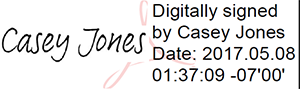
Per OBFS Policy 19.4.1 Electronic Signatures, the University can accept a digital signature provided that “[u]nits that are responsible for processing contracts may accept electronic signatures from the other party so long as the unit determines that the signature is affixed in a trustworthy manner and presents a reasonable level of reliability and authenticity (Identity Assurance).” For guidance in whether or not an electronic signature is acceptable, please reach out to OBDS (UIC) or CSO (UIS, UIUC, System offices).
Evergreen Contract
Contracts with automatic renewal clauses or provisions for renewals for a specified number of years. This has the benefit of allowing suppliers and agencies to establish longer-term working relationships. As a rule, the University does not enter into evergreen contracts. However, if an exception is needed, contact the relevant contract processing office. NOTE contracts subject to the State of Illinois Procurement Code cannot be evergreen and are limited to a term of 10 years.
A facsimile signature is a reproduction of a manual signature (i.e., scanned, photocopied, etc.). Comptroller signature delegates in OBFS routinely apply facsimile signatures to contracts using Adobe Pro and the Illinois Contract System (iCS). It is also common to accept a scanned, emailed copy of the other party's signature, which eliminates the need to send copies of contracts through the mail. This clause is generally included in all university contracts:
University’s Preferred Boilerplate Language: This contract may be signed in counterparts. Facsimile signatures constitute original signatures for all purposes.
Unexpected or uncontrollable events, including those caused by nature that can impact the contracts price, terms, and conditions. These events are not due to contractor negligence and may excuse contractor performance during the events and under certain conditions caused by them. Acts of God or disruptive conditions for which a contractor or carrier cannot be held responsible.
University’s Preferred Boilerplate Language: A party is excused from performing its obligations under this contract when conditions beyond its control and unforeseen by the parties make its performance commercially impractical, illegal, or impossible. Conditions of excuse include, but are not limited to: natural disasters, strikes, fires, war, terrorism and threats of terrorism, government actions, and acts or omissions of third parties. So long as the conditions continue, the party whose performance is affected shall keep the other party fully informed about the conditions and the prospects of their ending.
Headings
The section titles of a contract. For example, “Background,” “University Responsibilities,” “General Terms,” etc.
University’s Preferred Boilerplate Language: Headings in this contract are intended only to assist with readability and are not substantive.
Hold Harmless
See Indemnification.
As a state entity, the University is limited in its ability to indemnify or hold others harmless. This kind of language in contracts is often problematic and requires negotiation with the other party. The Office of University Counsel's website provides additional information about contractual liability and indemnity.
Independent Contractors
A worker/company hired by a business or public entity to accomplish a given result who has the right to control or direct his/her/its own work as to the details and means by which the desired results are achieved.
University’s Preferred Boilerplate Language: The parties are independent contractors with respect to each other. Nothing in this contract is intended to create any association, partnership, joint venture, or agency relationship between them.
Insurance
Requests from contracting parties for proof of University insurance coverage are processed through the University Office of Risk Management. A certificate of insurance can be requested through the University Office of Risk Management website using the Request for Proof of General Liability Coverage.
For facility use agreements where an external party is accessing University premises, the user (or tenant) may be required to provide evidence of liability protection to the University. The user may have access to this through their local insurance broker. Alternatively, the University offers access to a Tenants and Users Liability Insurance Policy (TULIP) issued through two different vendors, Marsh and Arthur J. Gallagher. More information about the TULIP programs can be found on the University Office of Risk Management website.
Integration
The contract document should contain or reference all information that constitutes and is relevant to interpretation of the contract. An integration clause makes it clear that a party cannot later refer to documents or communications, such as a phone call or email, that exist outside of the “four corners” of the contract in order to interpret the contract in a dispute.
University’s Preferred Boilerplate Language: This contract with its attachments, amendments, and incorporated references constitutes the parties' entire agreement regarding the subject matter.
Intellectual Property
Includes inventions, patents, copyrights, trade secrets, trademarks, technical data, or industrial designs that are generally protected and proprietary.
Intergovernmental Agreement/Contract
Also referred to an Intergovernmental Agreement (IGA). A contract in which one government entity contracts with another for the delivery of goods and services.
Jurisdiction
See Venue.
Length of Agreement.
See Term.
Liability
See Indemnification.
Damages that are agreed in advance by the parties when they enter into the contract in order to encourage performance and avoid expensive disputes later. Liquidated damages clauses should be used sparingly and must reflect a fair estimate of the cost of a breach. If the damages seem unreasonable and punitive, a court likely will not enforce the liquidated damages clause.
Non-Exclusivity
One party can provide the same services governed under the contract to other parties.
University’s Preferred Boilerplate Language: This contract is non-exclusive.
Parties
A University contract must be between the Board of Trustees of the University of Illinois on behalf of the appropriate college or department and another entity. For example:
University’s Preferred Boilerplate Language: The Board of Trustees of the University of Illinois on behalf of its College/Department/School of _________, on the Urbana-Champaign campus ("University") and ____________
The other party should be identified by its legal corporate/partnership or individual name.
Severability
If a court finds that a certain provision of the contract is illegal or otherwise not enforceable, then that particular language will be considered removed from the contract, but the rest of the contract will remain in effect so long as the primary purpose of the contract is not altered.
University’s Preferred Boilerplate Language: If any provision of this contract is held by a court of competent jurisdiction to be unenforceable, the provision shall be severed from this contract so long as severance does not affect the enforceability or essential purpose of the remainder of the contract.
The University Comptroller is the general fiscal officer of the Board of Trustees of the University of Illinois and is authorized to approve and execute, on behalf of the Board, contracts not expressly requiring prior, specific Board authorization. The Comptroller may delegate contract execution authority. Delegates who sign contracts on behalf of the Comptroller must have express authority to do so. Comptroller delegates are responsible for ensuring all required approvals are received and appropriate legal review is complete, before affixing the Comptroller's signature to a contract. Each contract processing office has Comptroller delegates who can provide this signature.
The OBFS Chief Business Officer may authorize a unit head, or other designated employee, to execute in the name of the Comptroller, specific unaltered templates for amounts less than $10,000 (see OBFS Policies and Procedures Manual, 19 Contracts). Contact the Contract Services Office to learn more about this signature authority.
Warning: If you sign a contract and are not an authorized delegate, the University is not a party to the contract unless it decides to ratify your unauthorized act. "Apparent Authority" does not generally apply to transactions involving the State of Illinois. If authorized university officials decline to ratify a contract, the other party's remedy for any breach or recovery on a contract claim will be from the person who signed without authority.
Sovereign Immunity
The University of Illinois is a “body corporate and politic” of the State of Illinois. Because of its status as a state entity, the university enjoys the protection of certain immunities and defenses under state and federal law, including the Eleventh Amendment to the U.S. Constitution. If the University contractually agrees to a choice of law provision that is not Illinois (or even agrees to comply with municipal codes), then it is likely waiving the legal protections it would otherwise enjoy. You should not agree to the application of other laws or the jurisdiction of any federal courts or any specific courts other than the Illinois Court of Claims without first consulting with legal counsel.
University’s Preferred Boilerplate Language: By entering into this contract, University does not waive the sovereign immunity or any other defenses and immunities afforded to it by Illinois and federal law.
Standard Forms
See Templates.
State Required Clauses
There are certain clauses that the University is required by law to include in its contracts. While there are several such clauses required for procurement contracts, there are only two that frequently apply to non-procurement contracts.
The following clause applies to all university contracts:
Contractor certifies that it will comply with all applicable provisions of the Equal Opportunity Employment Clause at 44 Ill. Adm. Code 750, Appx. A, which forms a part of this Contract by reference. (775 ILCS 5/2-105).
The following clause applies to contracts with an individual when the University is acquiring or providing goods or services:
If Contractor is an individual, or individual doing business as a sole proprietorship, partnership, or LLC, Contractor certifies it is not in default on an educational loan. (5 ILCS 385/3).
Subject Matter
It is important that the subject matter of the contract, whether related to the purchase of goods or services, use of a university facility by a third party, or international academic and research cooperation, is clear and unambiguous. The expectations of each party should be plain and specific. Make sure that the five Ws and H (Who, What, When, Where, Why, and How) are explicit in the text of the contract.
The Office of Business Services and the Office of University Counsel have created several pre-approved ("standard") contract templates to facilitate some common business transactions. Units may use these pre-approved templates to expedite the contract process, provided the terms of the contract require no alteration to the template language or legal form. These standard templates are available at Contracts Forms.
Every contract should have a defined term (start date and end date). In general, a University contract should not have a term of more than 10 years (this includes the initial term, plus any renewal periods allowed).
Termination
Does the contract allow both parties to terminate for cause and for convenience? If not, is there a reason why it does not? Are the circumstances allowing termination clearly identified and applicable to both parties? If not, why not?
The contract should require advance written notice of early termination, identify the contact person for each party to receive such notice, and their preferred mailing address. The contract should provide for payment to the University for services performed by the University up to the date of termination on a pro rata basis and/or for non-refundable obligations incurred by the University in anticipation of providing services.
Use of Name
The right for one party to use the other party’s name in certain circumstances.
University’s Preferred Boilerplate Language: [YOU/Other party] shall not use University's name or protected marks for any commercial purpose without University's advance written consent.
Under Illinois law, a contract claim against the University must be brought in the Illinois Court of Claims, which provides us with a cap on liability. The standard, preferred contract language is:
University’s Preferred Boilerplate Language: Any claims against University must be filed in accordance with the Illinois Court of Claims Act. This contract is non-exclusive.
Waiver
If one party to the contract agrees to waive a provision in the contract in a single instance (or multiple instances), that does not mean that that party waives the ability to enforce the that provision in the future.
University’s Preferred Boilerplate Language: The failure of either party to enforce any provision of this contract shall not waive the party's right to later enforce the provision or the contract.
Last Updated: April 27, 2020